
Product Introduction
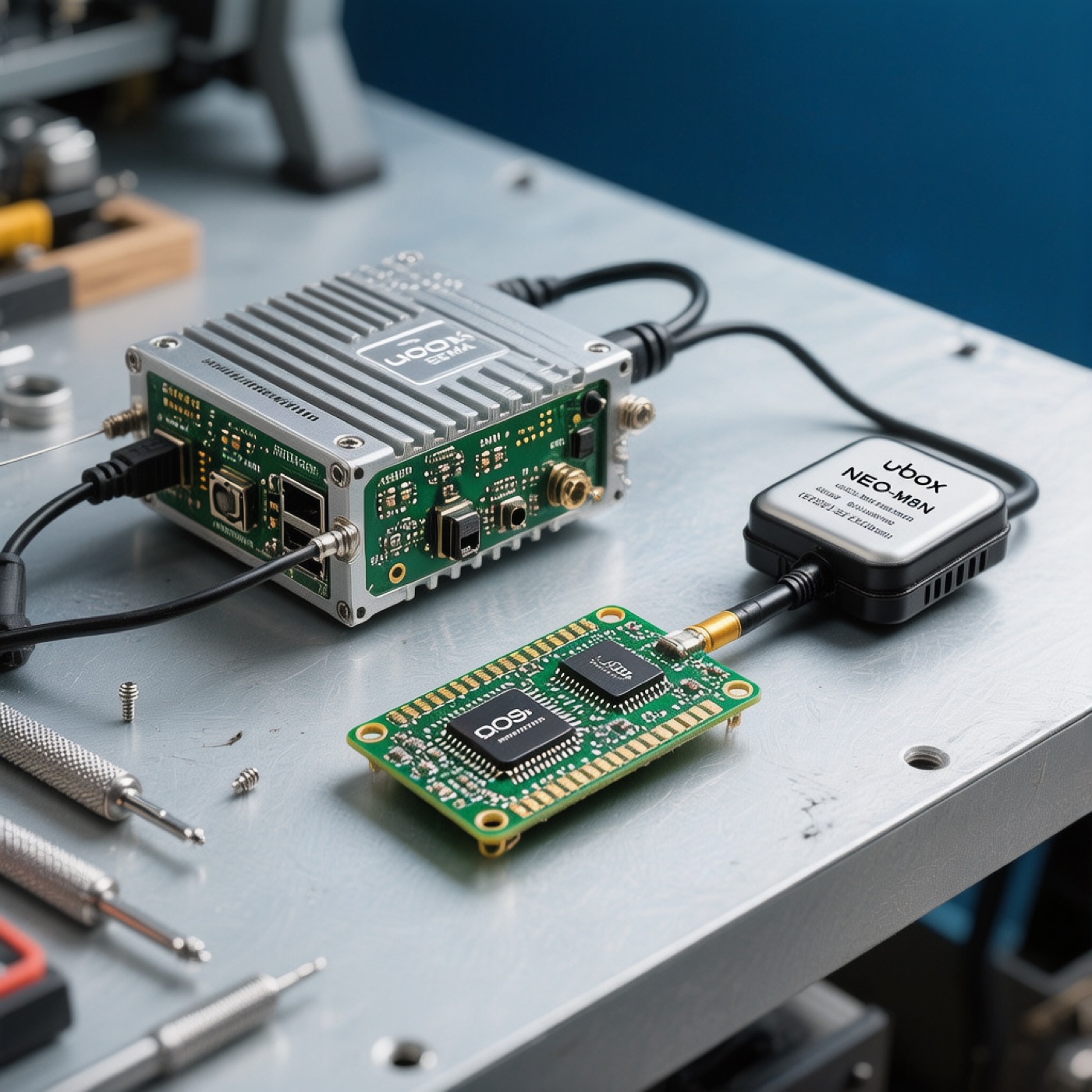
The NEO-M8N from u-blox is one of the most recognized GNSS modules in the drone market. It supports concurrent reception of GPS, GLONASS, BeiDou, and QZSS, offers a 72-channel architecture, reaches up to 10 Hz update rate, and has become a widely adopted standard for ArduPilot, PX4, and many custom UAV navigation stacks.
On the published UAVCHIP product page, the module is described with 2.5 m CEP GPS accuracy, 2.0 m CEP in combined GPS+GLONASS operation, hot-start and reacquisition times around one second, and interface support via dual UART, USB, SPI, and DDC/I²C. That feature mix matters because drone navigation modules are not isolated devices. They need to communicate cleanly with the flight controller, handle time pulse output, and integrate into a real airborne power and antenna environment.
For drone teams, the NEO-M8N is attractive because it is proven rather than experimental. It is fast enough for mainstream navigation, well documented, widely understood, and available in module form factors that fit both commercial and hobby-grade boards. That makes it useful for new design wins and replacement supply alike.
Why NEO-M8N became a default UAV GPS choice
- Reliable multi-GNSS capability without requiring complex host-side workarounds.
- Practical update rates for hover, waypoint, and return-to-home workflows.
- Strong ecosystem familiarity across autopilot communities and integrators.
- Useful interface flexibility for many FC and companion-board architectures.
Drone Application Scenarios
The most common NEO-M8N role is on medium and advanced drones that need more than manual stabilization. A multirotor using position hold, waypoint flight, return-to-home, or mission planning depends on the GPS module to feed accurate location and velocity data into the autopilot estimator. The better the GPS behavior, the more stable the navigation layer feels to the pilot or operator.
In mapping and inspection drones, NEO-M8N is often used as the baseline GNSS source while additional sensors such as magnetometers, barometers, and optical systems improve the final navigation result. It is not an RTK module, so it is not the answer to every precision problem, but it is more than sufficient for a large number of cost-sensitive professional UAV tasks.
In long-range platforms, GPS quality affects more than autonomous flight. It also influences geofencing reliability, recovery confidence after link loss, and operator trust in route execution. That is why the GPS module should be selected based on real navigation needs, not just on a line item that says “supports drones.”
Technical Parameter Analysis
| Parameter | NEO-M8N Value | Meaning for UAV Integration |
|---|---|---|
| GNSS Systems | GPS, GLONASS, BeiDou, QZSS | More constellation support improves lock robustness in mixed conditions. |
| Channels | 72-channel concurrent GNSS | Helps track more satellites and maintain better navigation stability. |
| Position Accuracy | 2.5 m CEP GPS, 2.0 m CEP GPS+GLONASS | Suitable for mainstream hold, RTH, and route-following use cases. |
| Update Rate | Up to 10 Hz | Enough for responsive position updates in typical drone control loops. |
| Supply Voltage | 1.71 V to 1.89 V VCC_IO, 2.7 V to 3.6 V VCC | Fits standard drone power architectures with correct regulator planning. |
| Tracking Sensitivity | −167 dBm | Important for maintaining performance under weak satellite signals. |
| Acquisition Sensitivity | −148 dBm | Affects cold-start and difficult-sky startup behavior. |
| Interfaces | 2× UART, USB, SPI, DDC/I²C | Provides flexible integration paths for many flight-controller designs. |
| Package | Castellated module, 12.2×16×2.4 mm | Module format simplifies integration compared with chip-level GNSS design. |
These parameters explain why NEO-M8N is such a comfortable fit for standard UAV navigation. The 10 Hz update rate is fast enough for most practical route correction and hold behavior. The multi-GNSS support improves satellite availability. The module form factor reduces RF design complexity for teams that do not want to build a GNSS subsystem from scratch.
Equally important is the protocol and interface support. When a module can talk via UART, USB, SPI, or DDC, engineering teams get more freedom in choosing how it will attach to the flight controller or companion computer. That makes layout planning easier and reduces redesign risk.
What Matters Most in Real Drone Navigation
Drone operators care about whether the aircraft holds position cleanly, reacquires navigation quickly after startup, and comes home confidently when link quality drops. Those outcomes depend on the full system: antenna placement, EMI environment, magnetometer calibration, firmware settings, and power cleanliness. But the GNSS module still defines the baseline capability. NEO-M8N is valuable because that baseline is reliable and widely understood.
Module placement matters more than many teams expect. A strong GNSS module mounted near high-current switching paths or noisy digital emitters will underperform. Antenna choice matters too. A low-quality patch or poor ground reference can erase much of the benefit of a good receiver. So when evaluating GPS performance, do not blame or praise the module in isolation.
For support teams, the wide ecosystem familiarity of NEO-M8N is a major advantage. There are more known-good wiring practices, more community configuration references, and more autopilot examples than with obscure alternatives. That saves time when shipping or servicing large fleets.
Alternative Models
If you need better performance, higher update rates, or a more premium roadmap, there are alternatives worth considering. But the right upgrade depends on what problem you are actually solving.
- NEO-M9N: A logical step up when newer generation performance and stronger capability margins are desired.
- NEO-6M: Lower-cost legacy option for simpler use cases, though with reduced performance expectations.
- RTK-capable solutions: Better for survey and centimeter-level tasks, but usually overkill for standard navigation drones.
If your goal is dependable autonomous navigation without excessive integration complexity, the NEO-M8N remains a rational selection. If your goal is premium precision workflows or a next-generation flagship stack, then higher-tier modules may justify the cost and integration overhead.
Selection Advice for Buyers
For procurement teams, the key question is whether the module supports the finished-aircraft experience you intend to sell. NEO-M8N is a safe choice for broad commercial and industrial use because it has proven itself at scale. That lowers the risk of choosing a cheap but poorly understood module that later creates support issues.
For engineering teams, the choice is usually about risk management. A proven GNSS module with known field behavior is often worth more than a slightly faster or more exotic option with weaker ecosystem support. Especially in UAV programs with limited iteration cycles, proven parts shorten integration time.
For maintenance buyers, exact module continuity matters. If a platform was tuned and validated around NEO-M8N, swapping to another GPS family without testing can affect configuration, lock times, and operational behavior. Replacement sourcing should respect the original design intent.
Need NEO-M8N modules for a drone program?
UAVCHIP can support quoting, availability checks, and sourcing for proven multi-GNSS drone modules.
View Product Page Submit RFQNeed related parts or pricing?
Use the product pages below for quick reference, or send your BOM for a direct quote.
Frequently Asked Questions
For NEO-M8N Drone GPS Guide: Multi-GNSS Performance, Specs, and Alternatives, the practical answer depends on your interface budget, firmware target, layout quality, and sourcing requirements. The safest approach is to validate the part in the final hardware environment before locking it into production.
For NEO-M8N Drone GPS Guide: Multi-GNSS Performance, Specs, and Alternatives, the practical answer depends on your interface budget, firmware target, layout quality, and sourcing requirements. The safest approach is to validate the part in the final hardware environment before locking it into production.
Treat replacement parts as engineering changes, not purchasing shortcuts. Even when the package and basic specs look close, you still need to confirm behavior under your own firmware, layout, and environmental conditions.
For NEO-M8N Drone GPS Guide: Multi-GNSS Performance, Specs, and Alternatives, the practical answer depends on your interface budget, firmware target, layout quality, and sourcing requirements. The safest approach is to validate the part in the final hardware environment before locking it into production.