Product Introduction
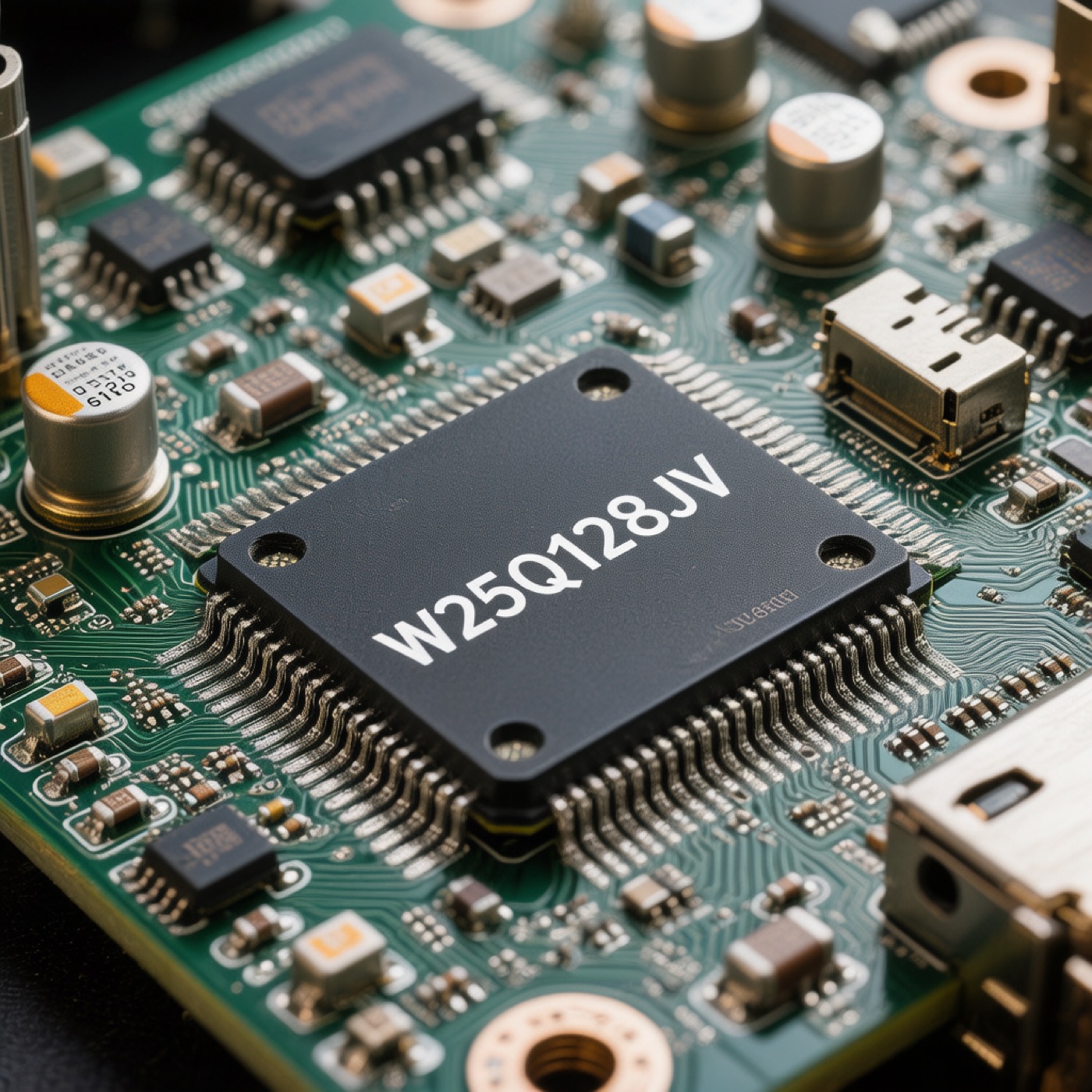
The W25Q128JV from Winbond is a 128 Mb serial NOR Flash device, equivalent to 16 MB of non-volatile storage. It supports standard SPI as well as Dual and Quad SPI modes, runs at up to 133 MHz in fast-read operation, and is widely used wherever embedded systems need code storage, configuration retention, or compact high-reliability data logging.
On the published UAVCHIP product page, the device is summarized as 16M × 8 organization, 256 sectors of 4 KB with 64 KB block structure, 2.7 V to 3.6 V supply, and package options including SOP-16, SOP-8, and WSON-8. It also specifies 100,000 erase/write cycles per sector and 20-year data retention. Those are practical embedded-system numbers, not just brochure highlights.
In UAV hardware, W25Q128JV is often not the main processor memory but the essential side memory that makes the rest of the system practical. It stores boot resources, firmware images, tune data, log buffers, and other persistent assets that should survive power cycling. For this reason, it appears frequently on flight controllers, companion boards, camera-adjacent systems, and various drone accessories.
Why W25Q128JV is useful in drones
- Enough density for firmware images, logs, and non-volatile configuration.
- Well-supported SPI / QSPI interface makes host integration straightforward.
- Common footprint and strong ecosystem familiarity reduce board risk.
- Balanced endurance and retention for embedded UAV operating life.
Drone Application Scenarios
One of the most common roles for W25Q128JV in drone electronics is Blackbox logging. Flight controllers that store debug traces locally need reliable write and erase behavior, predictable sector management, and enough density to capture meaningful flight sessions. With 16 MB available, designers can keep useful logs without moving immediately to larger, more complex storage devices.
Another major use is external firmware or asset storage. Some drone products keep recovery images, calibration data, font resources, or product configuration in NOR Flash so the main MCU does not need to reserve precious internal Flash for everything. This is especially useful when the main processor already runs near the limit of its built-in storage.
W25Q128JV is also relevant in payload and accessory electronics. Camera adapters, digital links, GPS companion boards, and sensor hubs often need compact, persistent memory for parameters or firmware update workflows. Because SPI NOR is easy to integrate and widely supported in bootloaders and embedded frameworks, it becomes a logical choice.
Technical Parameter Analysis
| Parameter | W25Q128JV Value | Why It Matters in UAV Systems |
|---|---|---|
| Memory Density | 128 Mb / 16 MB | Enough room for logs, firmware assets, and persistent configuration. |
| Organization | 16M × 8 bits | Simple byte-oriented host access for embedded controllers. |
| Sector / Block Structure | 256 × 4 KB sectors plus 64 KB blocks | Useful balance for parameter storage and larger erase workflows. |
| Interface | Standard, Dual, Quad SPI | Lets designers scale read performance without leaving common buses. |
| Clock Speed | 133 MHz fast read | Supports faster access for boot assets and log extraction pipelines. |
| Supply Voltage | 2.7 V to 3.6 V | Matches standard 3.3 V embedded power rails used in drones. |
| Endurance | 100,000 cycles per sector | Relevant for repeated logging and parameter update duty cycles. |
| Data Retention | 20 years | Good fit for long-lived stored configuration and firmware assets. |
| Package Options | SOP-16, SOP-8, WSON-8 | Provides flexibility for both repair-friendly and compact designs. |
What makes these specs useful is that they support real embedded trade-offs. A drone board does not always need the highest-capacity memory device. It needs a device whose density, interface complexity, and physical size fit the product. W25Q128JV lands in a sweet spot: enough storage for many real tasks, but without the routing, power, or controller burden of larger memory classes.
The 4 KB sector size is especially practical for parameter and settings management. Small updates do not force wasteful whole-chip operations, and logging strategies can be structured around predictable erase boundaries. That makes firmware development simpler and more robust.
Where It Fits in Drone Architecture
On a flight controller, internal MCU Flash is usually reserved for firmware itself. External NOR Flash like W25Q128JV extends the system. It can hold fonts for OSD, blackbox logs, mission data, backup profiles, or staged update packages. This separation helps keep the core firmware lean while giving the product more user-facing functionality.
On more advanced UAV boards, external NOR also supports safer update flows. A product can store a known-good image or recovery asset outside the main execution region. That matters commercially because failed updates are expensive support events. Good storage architecture reduces that risk.
For manufacturing teams, the part is attractive because it is common, well understood, and easy to integrate with standard embedded toolchains. That lowers design friction and increases the odds that second-source evaluation or replacement planning can happen smoothly if supply conditions change.
Alternative Models
There are many 128 Mb NOR Flash parts on the market, but replacements should be evaluated carefully. Density alone does not guarantee painless substitution. Command sets, timing, voltage behavior, and package variants all matter.
- GD25Q128 family: Often considered in cost-sensitive designs where software and electrical compatibility have been reviewed.
- MX25L12835F series: Common alternative in embedded hardware with strong market presence.
- IS25LP128 family: Another relevant option when specific sourcing or package requirements apply.
If your drone platform already uses W25Q128JV, the safest route for repair or repeat production is usually the same exact part. If you are starting a new board, then alternative evaluation can make sense as long as firmware, package, and timing assumptions are validated.
Selection Advice for Buyers and Engineers
For buyers, the most important question is not just capacity but reliability under the actual storage workload. Blackbox-heavy products, frequent firmware revisions, and field configuration updates create real cycle demand. A cheap memory part that behaves unpredictably under erase/write stress can cost more in support and returns than it saves in procurement.
For engineers, choose the memory strategy around your system lifecycle. If you need lightweight persistent storage with strong ecosystem support, W25Q128JV is a very rational answer. If you need dramatically more density, streaming-class throughput, or specialized boot behavior, you may need to move beyond this class of NOR device.
For repair supply and long-tail maintenance, the part remains useful because it is common enough that teams already know how it behaves. Known behavior reduces troubleshooting time, which is often more valuable than a small unit-cost difference.
Need W25Q128JV for UAV storage or logging?
UAVCHIP can help with NOR Flash sourcing, quote response, and inventory checks for drone electronics projects.
View Product Page Submit RFQNeed related parts or pricing?
Use the product pages below for quick reference, or send your BOM for a direct quote.
Frequently Asked Questions
For W25Q128JV Drone Storage Guide: NOR Flash Specs, Logging, and Firmware Use, the practical answer depends on your interface budget, firmware target, layout quality, and sourcing requirements. The safest approach is to validate the part in the final hardware environment before locking it into production.
For W25Q128JV Drone Storage Guide: NOR Flash Specs, Logging, and Firmware Use, the practical answer depends on your interface budget, firmware target, layout quality, and sourcing requirements. The safest approach is to validate the part in the final hardware environment before locking it into production.
For W25Q128JV Drone Storage Guide: NOR Flash Specs, Logging, and Firmware Use, the practical answer depends on your interface budget, firmware target, layout quality, and sourcing requirements. The safest approach is to validate the part in the final hardware environment before locking it into production.
For W25Q128JV Drone Storage Guide: NOR Flash Specs, Logging, and Firmware Use, the practical answer depends on your interface budget, firmware target, layout quality, and sourcing requirements. The safest approach is to validate the part in the final hardware environment before locking it into production.